

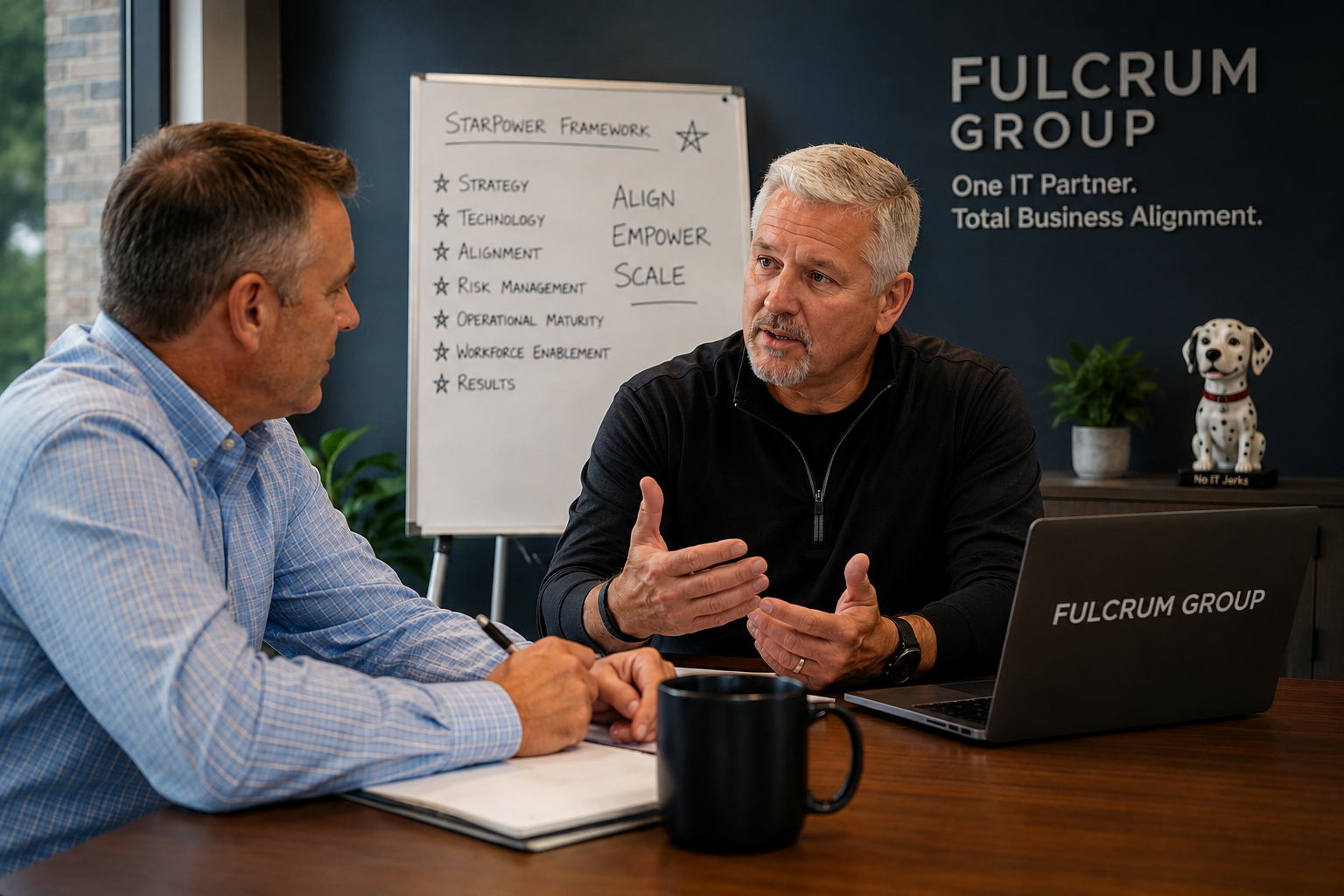
Leadership conversations around innovation, cybersecurity, and scalable technology strategy at The Fulcrum Group in Keller, Texas.
By Steve “The Doctor” Meek | Talk To Th3 Doc Podcast | The Fulcrum Group, Inc.
🎙️Doctor’s Diagnosis: A Podcast Doc-umentary: Scalable Leadership and Technology Alignment Episode 142
A few weeks ago on Talk To Th3 Doc, I sat down with Kurt Uhlir to talk about growth, leadership, and the invisible ways organizations accidentally slow themselves down. The funny thing is, we barely talked about technology directly at first. And honestly, that may have been the most important part.
Because after 30 years in IT leadership, I have learned something that sounds simple but tends to hit executives right between the eyes: Most technology problems are not really technology problems, they are leadership alignment problems wearing a technology costume.
Some organizations say they want innovation. Some say they want AI readiness. Others say they want operational maturity. But behind the scenes, every important decision still has to route through one exhausted executive like traffic merging onto I-35 during construction season (which is all year long). Which, if you live in DFW, means nobody is getting where they planned on time. And heaven forbid a train show up.
Kurt said something during the episode that stuck with me:
“You have to position yourself differently.”
Most people hear that as marketing advice but I heard it as leadership advice.
Because scaling organizations requires leaders to think differently about ownership, systems, accountability, and technology alignment. And that is exactly where we see organizations either accelerate, or quietly drift into operational chaos while pretending everything is fine because “the server still turns on.”
That is a little like saying my Dallas Mavericks season is going great because Champ the mascot showed up on time. The scoreboard still matters.
The Problem SMB Leaders Keep Running Into
One of the biggest myths in business is, “It is just faster if I handle it myself.” Now, temporarily? Sure. But long term? That mindset quietly becomes organizational technical debt.
We see this constantly across DFW organizations. A founder, COO, city manager, or department leader becomes the human router for every important decision:
- vendor approvals
- cybersecurity exceptions
- AI decisions
- purchasing
- escalations
- budgeting
- workflow approvals
- cloud questions
- compliance reviews
Eventually the company stops scaling around systems and starts scaling around personalities, which is dangerous. Not because leaders are bad people. Most of them are trying to help. But because organizations built around executive rescue eventually become fragile.
Kurt talked about healthy organizations moving decisions closer to the people actually serving customers. That is leadership maturity, and frankly, it is also technology maturity. At The Fulcrum Group, we see this same pattern during cybersecurity reviews, Microsoft 365 modernization projects, AI readiness discussions, and compliance assessments.
Technology cannot scale if leadership clarity does not scale first. That is why our STARPower Framework was never designed as “just another IT process.” It was designed as an operational maturity and alignment system.
The Fulcrum Way: Technology Alignment Before Technology Expansion
One thing I appreciated about Kurt’s perspective was how much it mirrored what we already believe internally at Fulcrum. Technology should never become random acts of modernization. Smaller organizations tend to have limited resources and random is more expensive and usually messy.
Some IT environments look less like a strategic roadmap and more like somebody lost a bar fight inside a Best Buy. Our STARPower Framework exists because businesses need a structured way to align:
- leadership vision
- operational maturity
- cybersecurity
- AI innovation
- budgeting
- scalability
- employee experience
- client trust
That alignment matters more now than ever and especially with AI.
Right now, executives across DFW are hearing nonstop promises about AI, Claudebot, Copilot, automation, Anthropic, AI assistants, analytics tools, and workflow modernization. But here is the uncomfortable truth:
AI amplifies organizational maturity but it does not magically create it.
- If vision is undefined, AI struggles at success.
- If workflows are unclear, AI accelerates confusion.
- If ownership is weak, AI magnifies inconsistency.
- If users are untrained, AI usage stalls.
- If governance is poor, AI increases risks.
- If documentation is tribal knowledge, AI exposes the gaps quickly.
Bruce Lee once said: “Absorb what is useful, discard what is not.” That is not a bad philosophy for technology strategy either.
At Fulcrum, our:
- STARPower
- STARLight
- STARMap
- SPOT Managed IT Services
- SPOT Managed Security Services
…all exist to create visibility before action.
That matters because organizations cannot improve what they cannot clearly see. Which sounds obvious until you realize how many businesses are still making six-figure technology decisions based on gut feelings, old assumptions, or whichever vendor bought lunch last week.
What Scaling Organizations Actually Do Differently
Kurt mentioned healthy conflict during the episode, and I loved that section. Because healthy organizations discuss and challenge ideas early instead of cleaning up preventable disasters later. That applies to technology leadership too.
Strong organizations:
- measure what matters
- create operational feedback loops
- reduce dependency on tribal knowledge
- standardize systems
- document processes
- prioritize proactively
- improve incrementally
That sounds suspiciously similar to ITIL, DevOps, Scaling Up, and every mature operational framework for a reason. The best organizations build flywheels, not heroics. Or as The Phoenix Project would put it, they stop relying on “Brent,” the one overloaded employee everybody depends on for everything.
Every company has a Brent somewhere.
- Sometimes Brent is a server admin.
- Sometimes Brent is a CFO.
- Sometimes Brent is the owner.
- Sometimes Brent is the only person who knows why the copier only works if you hit it like an old jukebox (The Fonz anyone?).
Scaling firms reduce “Brents” and that requires intent, focus and leadership discipline. This is being mindful of Theory of Constraints and how it can negatively impact an organization’s success.
Real-World Example: Innovation Without Alignment Usually Fails
We recently worked with an organization evaluating AI tools for productivity and automation.
On paper, they were ready:
- Microsoft licensing was in place
- cloud systems were modernized
- devices were current
- security stack was solid
But operationally?
- Different departments defined success differently.
- Ownership was unclear.
- Data quality varied wildly.
- Processes were undocumented.
- Approvals depended on two executives already overwhelmed.
The technology was not their bottleneck, alignment was.
So before employing broad AI adoption, we used our STARPower process to:
- establish baseline visibility
- identify operational friction
- clarify ownership
- prioritize workflows
- create measurable outcomes
- and then, reduce unnecessary complexity
That may sound bureaucratic or slower at first. It actually accelerates innovation long term. Because innovation without structure becomes chaos wearing futuristic branding. And trust me, nobody wants their AI rollout feeling like a deleted scene from Monty Python and the Holy Grail. “Run away!” is not a cybersecurity framework (but still hilarious all these years later).
Key Takeaways & FAQ
Why do leadership bottlenecks affect technology growth?
Because every delayed approval, unclear process, or executive dependency slows operational scalability and innovation adoption. Executive ownership is key for getting initiatives going but need prioritization, if technology is key to operations.
What is the STARPower Framework?
Fulcrum’s strategic technology alignment methodology designed to connect leadership goals, IT maturity, cybersecurity, AI readiness, and operational scalability. It is our process powered by our tools that aim to provide you lifecycle intelligence as an ongoing process.
Why does operational maturity matter before AI adoption?
AI amplifies existing processes. Strong systems improve faster. Weak systems become more visible faster. AI is like great power at high speeds but if the foundation is poor, it can lead to more or bigger accidents.
What makes Fulcrum different from many MSPs?
We focus on business alignment first, technology second. We prioritize the business context and organization uniqueness as our tagline says, One Technology Solution: Yours. Our goal is measurable operational maturity. We target transformational and not just transactional, like ticket closure.
Why does technology alignment matter for SMBs?
Misaligned systems increase friction, cybersecurity risk, employee frustration, and scaling limitations. Since SMBs typically have limited resources, the efficient use of the resources it does have increase the return on your investment of money and time.
What industries benefit most from this approach?
Pretty much all organizations with technology. Though we see more in manufacturing, nonprofits, local government, healthcare, professional services, and growing SMB organizations across DFW.
Final Thoughts
The organizations scaling best right now are not necessarily the ones spending the most on technology.
They are the ones creating clarity.
Clear ownership.
Clear systems.
Clear priorities.
Clear visibility.
Technology becomes powerful when leadership and operations are aligned around outcomes.
That is why at The Fulcrum Group, we believe:
Cheap IT saves pennies. Smart IT makes dollars.
And honestly, after my conversation with Kurt, I think he would probably agree.
Call To Action
If you missed Episode 142 of Talk To Th3 Doc, I highly recommend listening to the full conversation with Kurt Uhlir.
We covered:
- scalable leadership
- servant leadership
- buyer psychology
- operational maturity
- technology alignment
- business growth systems
Watch on YouTube:
📺 Talk To Th3 Doc YouTube Playlist
Listen on your favorite podcast platform:
🎧 Talk To Th3 Doc Podcast Platforms
Or connect with The Fulcrum Group to schedule a strategic technology alignment discussion for your organization:
🌐 The Fulcrum Group Podcast Page
About the Author – Steve “The Doctor” Meek, CISSP
Steve “The Doctor” Meek, CISSP, is a DFW-based IT strategist, cybersecurity leader, podcast host, and co-founder of The Fulcrum Group, Inc., a 24-year technology legacy in North Texas. A recipient of the 2024 MSP Titan of Industry Award for Community Impact, Steve helps CEOs, city managers, healthcare leaders, manufacturers, nonprofits, and other SMB decision-makers navigate cybersecurity, AI readiness, Microsoft 365 modernization, operational resilience, and smarter technology planning. As host of Talk To Th3 Doc, he explores leadership, ownership, cybersecurity, AI, and business technology topics to uncover practical insights leaders can use.
Founded in Keller, Texas, The Fulcrum Group delivers relationship-centered DFW managed IT services through its SPOT Managed IT Services and SPOT Managed Security Services platforms. Using its STARPower strategic technology alignment process, STARLight visibility layer, and STARMap technology roadmaps, Fulcrum helps organizations see what is working, what is aging, what is at risk, and what should be improved next. Fulcrum’s approach is built around a simple belief: Cheap IT saves pennies. Smart IT makes dollars. With a 100% Texas-based team and a No IT Jerks philosophy, Fulcrum has earned repeated national recognition on the MSP 501 and CRN Top 500, serving SMBs, local governments, and mission-driven organizations across North Texas.