


By Steve “The Doctor” Meek | Talk To Th3 Doc Podcast | The Fulcrum Group, Inc.
🎙️Doctor’s Diagnosis: A Podcast Doc-umentary: Cybersecurity Program Maturity Episode 140
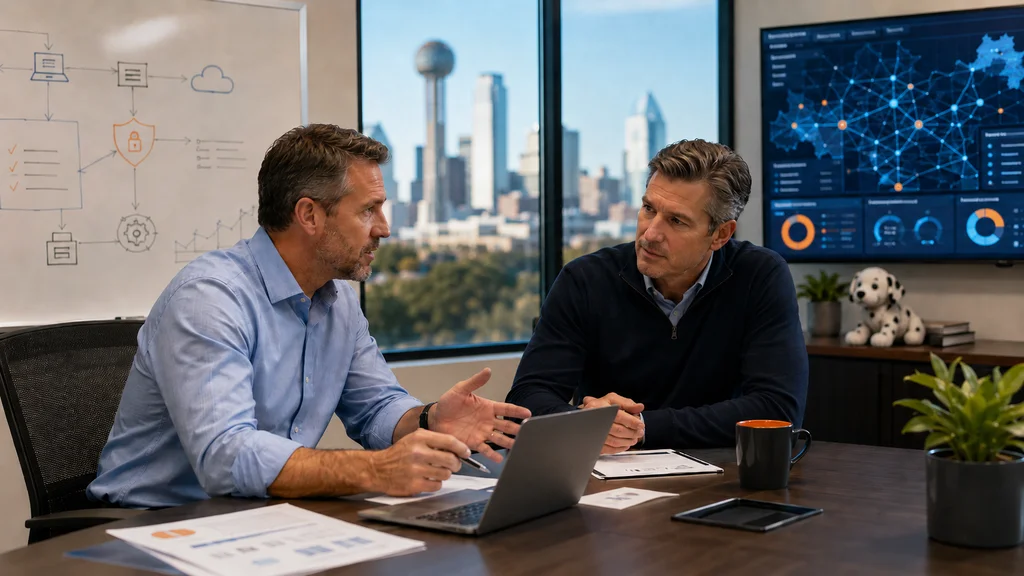
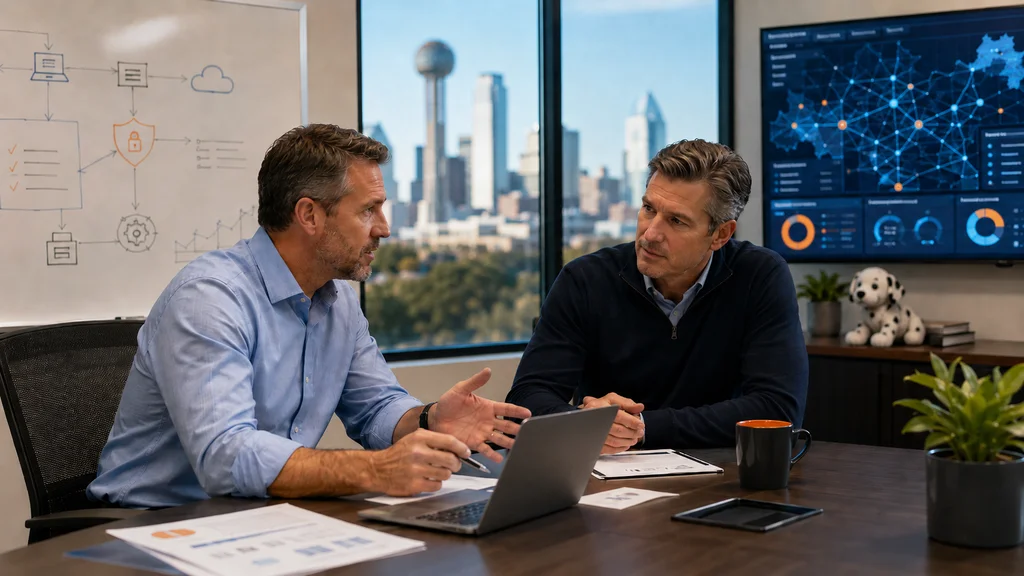
Peter Gailey joined me on Talk To Th3 Doc to unpack a question that keeps showing up in boardrooms, leadership meetings, and hallway conversations across DFW: how do you build a cybersecurity program that actually fits a growing organization? I walked away thinking about something I have seen for years, that technology rarely fails because leaders don’t care, it usually fails because the business outgrows its current habits, before it upgrades the needed discipline.
Introduction – Lead with Why
At The Fulcrum Group, we don’t believe technology should be a pile of tools sitting in the corner like gym equipment people bought in January and forgot by March (that can also be a virtual pile). We believe technology should help a business scale, reduce user “friction”, protect what matters, and be a part of continuous innovation.
That is why I liked this conversation with Peter.
We discussed how cybersecurity is not just about avoiding disaster. It is about creating the kind of operational trust that lets a firm grow with confidence. If leaders do not know what they have, what matters most, and what risks are quietly multiplying in the background, they cannot align technology to vision. They are guessing. And guessing is always a poor growth strategy, whether the guess is financial, staffing or technology. Peter said it plainly in the episode:
“Get a baseline. Just understand what you have.”
That line is simple, but around here we know simple is not the same as easy. Almost every cybersecurity framework starts with “know what your hardware assets are” and “know what your software assets are” as the first two checklist items.
The Problem or Question – Define the Challenge
A lot of SMBs, nonprofits, municipalities, and manufacturers may still be managing cyber risk one surprise at a time. Peter described it as “chasing the shiny penny,” and that is about as accurate as a Texas weather forecast in August, hot, intense, and headed your direction, whether you planned for it or not.
The problem is not always laziness, I feel it is inertia because in non-enterprise organizations, leaders wear multiple hats and are busy. Vendors promise silver bullets or may not ask many questions before making recommendations. Compliance language seems thick enough to stop a bullet with all the rarely used in daily language terms. Before long, the company buys one or more tools, checks a few boxes, and convinces itself that doing any activity equals huge progress.
It does not.
In the podcast, Peter made the point that many organizations are still playing cybersecurity whack-a-mole instead of using a program approach. That matters because scaling firms need more than reactions. They need priorities, accountability, and a roadmap. They need to know the difference between urgent noise and strategic work.
This is where many executives get stuck. They hear about ransomware, business email compromise, AI risk, vendor risk, NIST, CIS, HIPAA, PCI, and enough acronyms to make a normal person consider a long nap. Then they do what people do when overwhelmed. They delay.
As a student of history, I will say this kindly: civilizations, teams, and companies rarely drift into excellence. They drift into entropy. That is why leadership has to step in.
The Fulcrum Way – Tie the Solution to SPOT Managed Services or STARpower
At Fulcrum, this is exactly why we built our SPOT Managed IT Services and SPOT Managed Security Services around a broader operating philosophy, not just support tickets. We call that philosophy STARPower™. It is our way of helping organizations align technology to business goals through visibility, planning, prioritization, measurement, and continuous improvement.
STARPower™ works because scaling firms do not need random acts of improvement. They need a cycle.
First, we establish the current state. That may include inventory, documentation, security posture, lifecycle issues, support patterns, and stakeholder concerns. Our STARLight tool helps put it all into one place for easy reporting for what we consider to be most valuable, visibility leading to insight. Peter’s baseline point fits that perfectly. If you do not know where you are, every road sign is just decoration.
Next, we define where the business wants to go. Growth or reduction? Resilience locally, or in the cloud? Better compliance or pre-compliance assessment? A cleaner path to AI adoption or getting started with data governance? Or simply less reactive noise to allow the organization to focus better? This is where leadership matters. Leaders and managers are the subject matter experts on the business. Our job is to help translate that into practical technology direction that makes sense for the desired goal.
Then we prioritize. Not twenty things. Two or three important things first, then the next two or three. That is one reason our clients value quarterly success reviews and proactive planning. Growth gets messy when everything is labeled top priority. That is not strategy, that is just louder confusion.
Then we execute in measured steps. Good IT leadership is not a cannonball into the deep end. It is disciplined forward motion. ITIL v5, service discipline, CIS Critical Security Controls, FinOps and our own STARPower™ rhythm all point to the same truth, steady improvement beats dramatic chaos.
And yes, we do all of that with our No IT Jerks philosophy intact. Because leaders do not just need competence. They need calm, clarity, and a partner who can explain things without sounding like they were raised by a compliance manual.
Real-World Example or Metric – Insert Supporting Data or Case Insight
One of the most useful parts of Peter’s conversation was his litmus test for maturity. He said if an organization cannot produce a solid inventory of its IT assets within 24 hours, it is not secure. That is a strong statement, but it rings true. Inventory is not glamorous, but it is foundational.
He also reminded listeners that business email compromise remains a major threat and that cybersecurity belongs at the CEO level because it is one of the biggest business risk areas organizations face. That is especially relevant for SMBs trying to scale, because growth increases complexity. More people, more tools, more vendors, more exceptions, more opportunities for something to slip through the cracks.
And now AI has entered the chat.
Peter and I also talked about AI risk and third-party exposure. That is not a future issue. It is a current alignment issue. Attempted innovation without governance is like handing a lightsaber to a toddler (not Grogu), fascinating and energetic maybe, but likely to end badly. The firms that scale well will be the ones that align innovation to internal policy, defined processes, prioritized business objectives, and key human oversight.
That is another reason STARPower™ matters. It gives clients a framework to identify and bring new technology into the business, in a structured way that supports adoption and growth, instead of multiplying chaos.
Key Takeaways / FAQ
Where should an SMB start with cybersecurity?
Start with a baseline. Identify your assets and your users. You first need them documented and cleaned up to figure out your gaps and biggest business risks.
Is cybersecurity just an IT issue?
No. It is a leadership issue, a budget issue, an operations issue, a trust issue and in some cases, a company valuation issue.
How does this relate to scaling a firm?
The authors of the ScalingUp framework view alignment as the fundamental linchpin that dictates whether growth leads to success or chaotic failure. If technology is reactive, undocumented, or disconnected from strategy, growth gets expensive fast (or unprofitable).
What does Fulcrum do differently?
We combine managed IT, managed security, strategic reviews, lifecycle visibility, and a relationship-centered approach through SPOT Managed Services and STARPower™.
Why is innovation part of this conversation?
Because secure, aligned systems create space for innovation. Disorder does not scale well and why there should always be an interest in reducing noise from tickets.
What is the biggest mistake leaders make?
They assume activity means maturity. IT teams can do all kinds of technical tasks, but they can’t make business decisions about how much risk to tolerate, allocate budget in opportunity areas, or define organizational priorities.
Call to Action – Encourage Next Step
If this topic hit home, I would encourage you to do two things.
First, go watch or listen to Episode 140 of Talk To Th3 Doc with Peter Gailey. It is a practical conversation, not a fear parade. Second, if your organization is growing and you know your technology needs a better plan, connect with us through the podcast page or reach out to The Fulcrum Group for a strategy conversation. We serve DFW organizations that want more than support. They want alignment, momentum, and a team that can help them scale without losing the plot.
Usually the next right step is not buying another tool. Sometimes it is finally getting honest about whether you know where you are, where you want to go, and who should help you get there.
And in the spirit of Mark Twain, I will put it this way:
it is easier to explain a problem before it ruins your day than after it ruins a whole quarter.
About the Author — Steve “The Doctor” Meek, CISSP
Steve “The Doctor” Meek, CISSP, is a DFW-based IT strategist, cybersecurity leader, podcast host, and co-founder of The Fulcrum Group, Inc., a 24-year technology legacy in North Texas. A recipient of the 2024 MSP Titan of Industry Award for Community Impact, Steve helps CEOs, city managers, healthcare leaders, manufacturers, nonprofits, and other SMB decision-makers navigate cybersecurity, AI readiness, Microsoft 365 modernization, operational resilience, and smarter technology planning. As host of Talk To Th3 Doc, he explores leadership, ownership, cybersecurity, AI, and business technology topics to uncover practical insights leaders can use.Founded in Keller, Texas, The Fulcrum Group delivers relationship-centered DFW managed IT services through its SPOT Managed IT Services and SPOT Managed Security Services platforms. Using its STARPower™ strategic technology alignment process, STARLight visibility layer, and STARMap technology roadmaps, Fulcrum helps organizations see what is working, what is aging, what is at risk, and what should be improved next. Fulcrum’s approach is built around a simple belief: Cheap IT saves cents. Smart IT makes dollars. With a 100% Texas-based team and a No IT Jerks philosophy, Fulcrum has earned repeated national recognition on the MSP 501 and CRN Top 500, serving SMBs, local governments, and mission-driven organizations across North Texas.
Watch on YouTube:📺 https://youtu.be/B2xecs-UovE?si=kftowWWidO30C-4u
Listen on your favorite podcast platform:🎧 https://pod.link/1807560282